- EPA Lead-Safe & OSHA Certified
- Free In-Home Consultation
We perform standard dustless popcorn ceiling removal on homes built after 1980. For properties constructed prior to 1980, we offer certified laboratory asbestos testing before removal to verify safety, or require a verified negative asbestos laboratory test certificate in compliance with EPA NESHAP safety regulations.
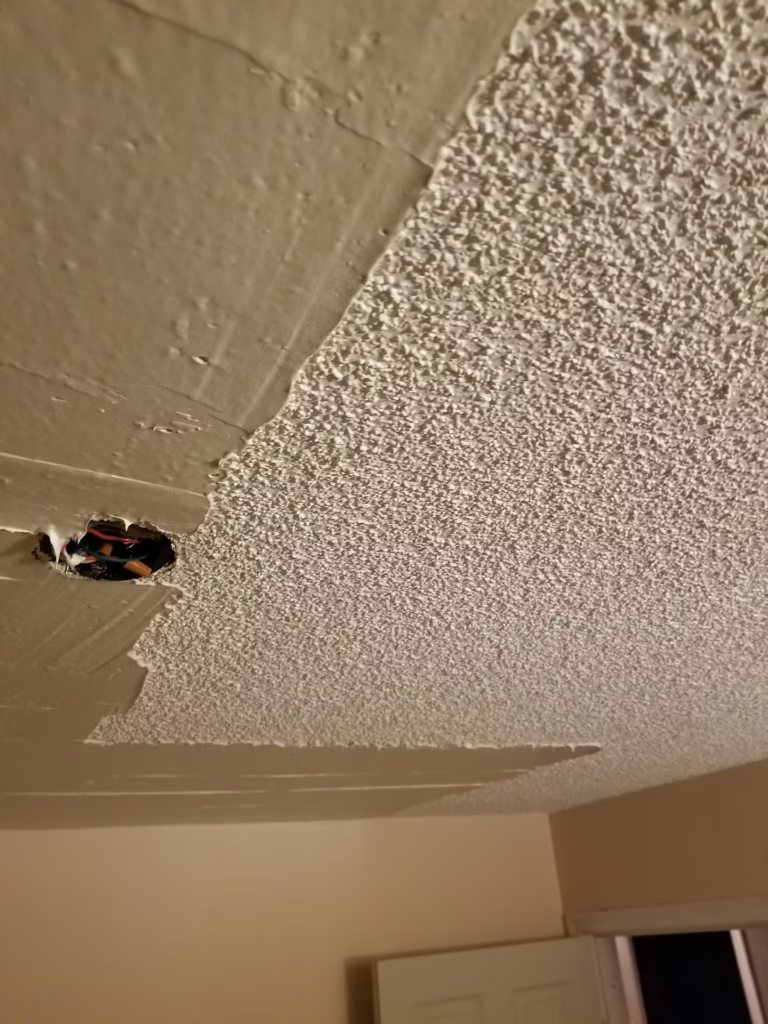
Acoustic “popcorn” or “cottage cheese” textured ceilings were popular from the late 1950s through the 1980s as a quick way for builders to hide imperfect drywall joints and dampen sound. Today, they collect dust, trap cooking grease, cast harsh shadows, and instantly date your home’s interior.
Removing popcorn texture increases perceived ceiling height, dramatically improves indoor lighting distribution, and boosts property appraisal value. Following texture removal, our master finishers apply two full coats of skim compound for a glass-smooth Level 5 finish before our interior painters apply ultra-flat ceiling coatings.
Why the construction build year matters and how CJ Home Projects ensures 100% household safety.
| Home Build Era | Asbestos Risk Level | Federal Regulatory Status | CJ Home Projects Protocol | Testing Requirement |
|---|---|---|---|---|
| Pre-1978 Construction | High (Up to 10% Chrysotile Asbestos) | Asbestos widely permitted in textured ceiling sprays | Containment, sample collection, lab testing prior to disturbance | Mandatory Accredited Lab PLM Test |
| 1978 to 1980 Transition | Moderate (Warehouse stock phase-out) | EPA 1978 ban enacted, but builders could use existing inventory | Verification of build certificate or certified test sample | Lab Testing Strongly Advised |
| Post-1980 Construction | Zero Asbestos (Paper/Styrofoam aggregates) | Federal ban fully enforced across all manufacturing chains | Immediate dustless wet scrape, Level 5 skim, prime and paint | No Testing Required |
In accordance with the EPA Asbestos NESHAP Rule and OSHA 1926.1101 standards, disturbing asbestos fibers without specialized containment can release microscopic hazardous respirable fibers. If your home was constructed before 1980, our team takes certified 1-square-inch core samples and submits them to an independent NVLAP-accredited laboratory for Polarized Light Microscopy (PLM) analysis. If negative, standard removal proceeds immediately.
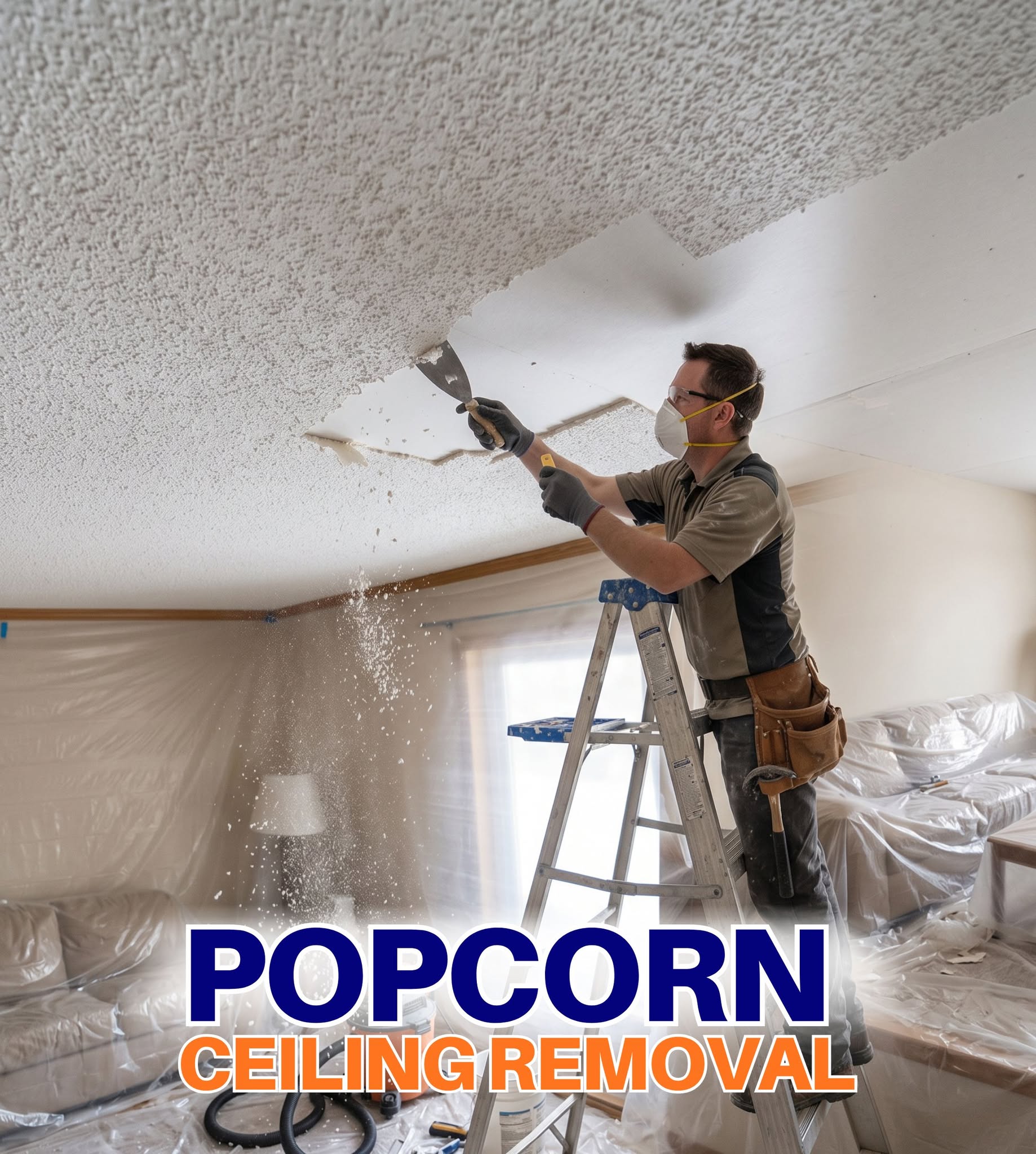
We seal all floors with heavy 6-mil poly plastic, mask all walls from top plate to baseboard, tape all electrical outlets, and cap HVAC registers to prevent air migration.
The texture is evenly saturated with an organic enzyme wetting agent that breaks the binder glue without over-saturating or damaging the underlying paper backing of the sheetrock.
Technicians use specialized 12-inch rounded ceiling scrapers with attached catch-bags to shave the softened acoustic stipple cleanly down to raw gypsum drywall with zero gouging.
Builders frequently left rough drywall joints under popcorn. We re-tape loose seams, sink popped screws, and repair imperfections using fiberglass mesh tape according to drywall repair standards.
We apply two complete ultra-thin skim coats of lightweight joint compound across 100% of the ceiling, followed by Festool HEPA dustless sanding to produce a glass-smooth surface.
We roll specialized PVA high-adhesion primer to seal the porous compound, followed by two coats of premium dead-flat ceiling paint to eliminate light reflection and flashing.
Yes, but painted popcorn ceilings require dry-scraping or full surface skim-over because latex paint forms a waterproof barrier preventing water mist from penetrating the texture.
In painted situations, we either score the paint layer with diamond mesh abrasives or apply a direct Level 5 high-bonding skim coat over the entire texture to achieve a smooth finish.
A standard 1,500 to 2,000 square foot home typically takes 2 to 3 business days from initial plastic masking to final ceiling coat and complete cleanup.
Individual rooms (such as a master bedroom or living room) are completed in just 1 to 2 days.
Schedule your free in-home ceiling inspection and fixed-price quote today.